
Oct 14 2025
• By Alaric DeArment
Speakers at the BioFuture conference discussed how confusing the policy environment has become, skepticism about AI/ML in drug development, the future of cancer immunotherapy, ideas for accelerating rare disease therapies and where the biopharma financing market is going.
Biopharma Is In A ‘Confusing Period’
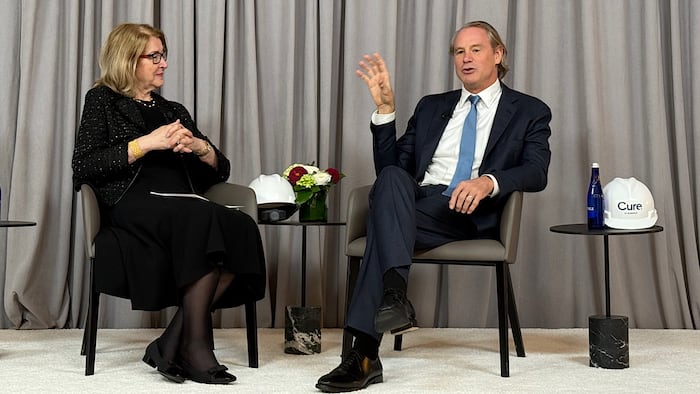
Health care has gone from picking up after a drought in the latter half of 2024 to a “confusing” period after the inauguration of President Donald Trump and his appointment of Robert F. Kennedy Jr. as secretary of the Department of Health and Human Services, Deerfield managing partner James Flynn said in a fireside chat that kicked off the conference Oct. 13.
“It’s been a pretty confusing period,” Flynn said. “Health care started picking up in about third quarter of last year, and then after RFK was appointed, biotech went down 40% in sort of a straight line through April, and that was accompanied by a sort of bewildering list of things to assess.”
That list includes the questions that have dogged the biopharma industry for months now: What will the tariffs do? What is most favored nation (MFN) pricing going to do? What’s going to happen with Inflation Reduction Act price negotiation for Medicare? What’s going to happen in budget reconciliation with patient coverage, and who will and will not be insured?
“I think there is a point to shaking some things up, but the manner of it just created intense uncertainty throughout everyone who is trying to assess or work for any of these bodies,” Flynn said. “And if you were a generalist looking at health care, there is no way you are going to invest in health care.”
Citing the recent news that the Trump Administration would levy 100% tariffs on China, causing a drop in the markets, Flynn said a pattern had emerged in these types of announcements.
“That’s kind of been the pattern – it’s that there’s been a, ‘We have to shake this up, and you better come to the table’ sort of headline, followed by a much more reasoned endpoint,” he said. “And it’s really hard to integrate those things in your mind because, on the one hand, you have to assess how bad can it be – you really don’ t know how bad it can be – but at the end of the day, where we see resolution, it’s fine.”
Should We Be More Critical Of AI/ML Drug Discovery?
A plethora of companies have emerged in recent years touting their use of artificial intelligence and machine learning (AI/ML) in drug discovery and development, but when it comes to actual products in the pipeline, the field remains largely in its infancy.
As such, Bigyan Bista, the head of business development for drug discovery firm Enveda, advocated a more skeptical view toward AI/ML-focused companies.
“We started with a humble belief, which was that any company that calls itself ‘AI for drug discovery’ should have drugs in the pipeline, and ideally drugs that are their own,” Bista said in an afternoon panel about the “TechBio” future.
Enveda, based in Boulder, Colo., has an AI-based drug discovery platform and a pipeline in a variety of indications, particularly inflammatory conditions. ENV-294, which the company touts as having efficacy comparable to JAK inhibitors and safety comparable to IL4/IL13-targeting drugs, is in Phase Ib development for atopic dermatitis. ENV-6946 and ENV-308 are in investigational new drug-enabling studies, respectively for inflammatory bowel disease and obesity.
“I’m a scientist by training with a very healthy dose of skepticism about most outlandish claims that AI bio companies make,” Bista said.
He listed what he called “three flavors of mistakes, which I consider to be like fatal flaws in terms of making an investment in an AI bio drug-discovery company.”
These “flavors,” he said, are in-licensed assets, which he called a mismatch with calling oneself an AI for drug discovery company; chasing “tiny, tiny indications” that do not underwrite valuations; and lead assets that are just “scaffold hopping or a pattern-breaking exercise disguised under machine learning.”
He added that those red flags may not be obvious to generalist investors, which makes it important to have expertise in the field.
“Just applying that filter was able to take care of 99.99% of companies as probably un-investable,” he said. “I was always looking for proof points, and the proof has to demonstrate itself in the pipeline.”
IO Needs To Push The Margins
While immunotherapies have made significant strides in the field of oncology, there are still limitations in their efficacy, and industry needs to focus on how to improve outcomes and what the next generation of immuno-oncology treatments will look like, panelists suggested at an Oct. 13 panel on revolutionary cancer treatments.
Naya Therapeutics CEO Daniel Teper pointed to multiple myeloma as an example of the persistent question of whether the market is satisfied, meaning that there’s not a need for new therapies.
“People say we don’t need something new for, let’s say, myeloma because we have [Johnson & Johnson’s Darzalex (daratumumab)], we have CAR-Ts,” he said. But even though Darzalex has been moved to frontline therapy regimens, half of patients are still minimal residual disease (MRD)-positive, which is correlated with poorer disease prognosis.
CAR-Ts – such as Johnson & Johnson/Legend Biotech’s Carvykti (ciltacabtagene autoleucel) and Bristol Myers Squibb’s Abecma (idecabtagene vicleucel) – are highly effective, Teper added, but the “bad news” is that they’re only used in a relatively small number of patients.
“And when patients relapse post-CAR-T, there aren’t that many solutions,” he said. “So, I think we have to place the bar quite high when we’re developing new drugs and say we’re not looking for a marginal effect or just for combination therapy – we need to have [more effective] monotherapy.”
In other words, he said, therapies can be given on top of standard of care, but the aim should be to develop therapies with 20%-40% response rates as opposed to response rates in the single digits and survival improvements of one or two months.
Still, Gerald Commissiong, the chief business officer of OS Therapies, said combination treatments are likely the way forward. He highlighted early studies OS had done combining Merck & Co.’s PD-1inhibitor Keytruda (pembrolizumab) with its own lead program, OST-HER2, which uses the immune-stimulatory effects of Listeria bacteria to initiate an immune response targeting HER2.
“Obviously, there’s a lot of interest in single-agent improvements,” Commissiong said. “But I do think that combinations are where the action is going to be, and certainly because immunotherapies have multiple mechanisms typically going on at the same time, making sure that they don’t run counter to each other … will probably be the next step.”
Looking For Ways To Accelerate Rare Disease Therapies
As much as has been done to smooth the way for development of rare disease drugs, panelists at BioFuture believe more can be done to accelerate the development of new treatments for rare diseases.
Jennifer Schranz, the global head for rare diseases at Ipsen, said that the US Food and Drug Administration has the authority, under current legislation, “to actually work with sponsors to think out of the box with respect to study design … and analysis plans.”
It’s important to work with the agency early on clinical design, she added.
It’s also a matter of being faster in business development, such as evaluating an asset that is ready for an IND filing and determining whether there are faster ways to get into the clinic.
“Do you do participants who are healthy, or do you go to participants with the disease right away?” she said. Other potential strategies include combining healthy subjects with an older population with the disease that’s stable if the goal is to determine the pharmacodynamics and pharmacokinetics of a product, or doing a Phase I study in another country and then filing an IND with the FDA so that sponsors have data when they’re ready to start clinical development in the US. Other factors include early biomarker development and patient voices.
“I think it goes back to a few things that we have to make sure we get right, and it’s hard to,” she said. That means “understand the disease, the natural history, understand what’s clinically meaningful to patients, how they feel, function, survive.”
What’s Next For Biopharma Financing? (No One Knows)
While there have been signs of improvement in what has been a bleak year for biopharmaceutical economics, with VC tracking up and the few companies that have had an IPO showing healthy returns. But that may not translate into a robust recovery next year.
Philip Ross, vice chairman for global healthcare investment banking at Jefferies, said he was uncertain whether there would be a “healthy market” of 25-30 IPOs per year even in 2026.
“We have a [Consumer Price Index] print on Wednesday,” he said during an Oct, 13 financing panel. “I have no idea what it’s going to say around government shutdowns and how to breathe through that.”
At the same time, Evercore ISI analyst Umer Raffat said M&A activity has seen an uptick, with the list of acquirers going “from 10 to 20” and including players that used to not be on the list.
“Legitimate acquirers, there’s been a big sea shift, I think, on like Lundbecks and UCBs – those are all acquirers,” he said, referring to increased BD activity for mid-sized firms. “That was never part of the list.”
Bristol Myers Squibb’s acquisition on Oct. 10 of Orbital Therapeutics – a specialist in in vivo CAR-T therapies – is also an encouraging sign biopharma companies have a renewed appetite for risk taking given that Orbital is a preclinical company.
Raffat said it seems as though the IPO window could possibly open, even if that might not happen immediately, and the impact of policies like tariffs and potential partnering bans could determine how long the list of the companies going public is.
“It will partially depend on whether China’s blocked or not,” he said. “That’s what’s pending in DC.”